
016 In-Place Family List
Chris McKeown / July 1, 2025
Lists
Overview
In-Place Family List loads every in-place family in the project into a grid, giving you a complete inventory with category information and element IDs. Use it to locate in-place families that are difficult to find manually, navigate directly to their host views, and delete or isolate them in bulk. In-place families carry a well-known performance and coordination overhead — this tool is the fastest way to find and clean them up before a project handover or BIM compliance check.
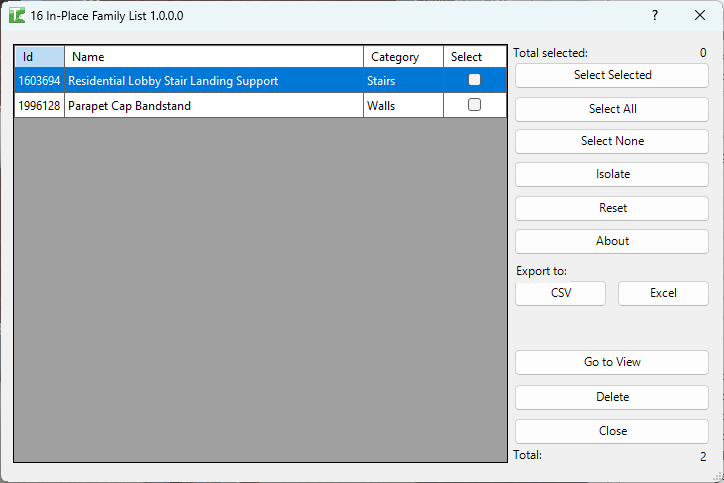
Table of Contents
Key Features
- Loads all in-place families automatically on dialog open
- Grid columns: Id, Family Name, Category, Select
- Go to View — opens the host view and highlights selected in-place families in Revit
- Delete Selected — bulk-deletes ticked in-place families with a confirmation prompt; transaction: "Delete inplace Families"
- Isolate — isolates selected elements in the current view for close inspection
- Reset — resets view isolation
- Export to Excel / Export to CSV — saves the current grid for reporting
- Multi-select: Select Selected / Select All / Select None
- Confirmation: "X passed. Y failed."
Requirements
- Any Revit project document
- A valid Kiwi Codes Bonus Tools licence must be active
Running the Tool
Launch
Find In-Place Family List on the Bonus Tools Ribbon or use 115 Search Tools.

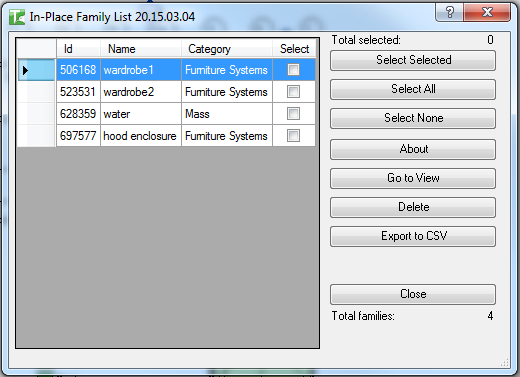
The dialog opens and immediately loads all in-place families in the project:
| Column | Description |
|---|---|
| Id | Revit Element Id of the in-place family instance |
| Family Name | The name of the in-place family |
| Category | The Revit category the in-place family was created in |
| Select | Checkbox — tick to include in the next action |
The Total counter at the bottom shows the total number of in-place families in the project. Click any column header to sort.
Step 1 — Select in-place families
Tick checkboxes in the Select column, or use the selection buttons:
| Button | Action |
|---|---|
| Select Selected | Toggle the checkbox for the currently highlighted row(s) |
| Select All | Check all in-place families |
| Select None | Uncheck all in-place families |
The Total selected counter updates as you make selections.
Step 2 — Navigate to a family (Optional)
To confirm which in-place family a row represents:
- Select the row(s)
- Click Go to View
Revit opens the host view and highlights the selected in-place families:
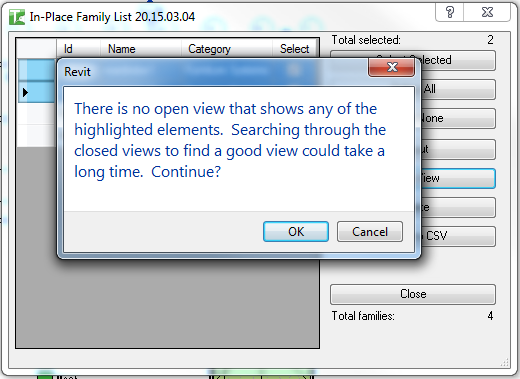
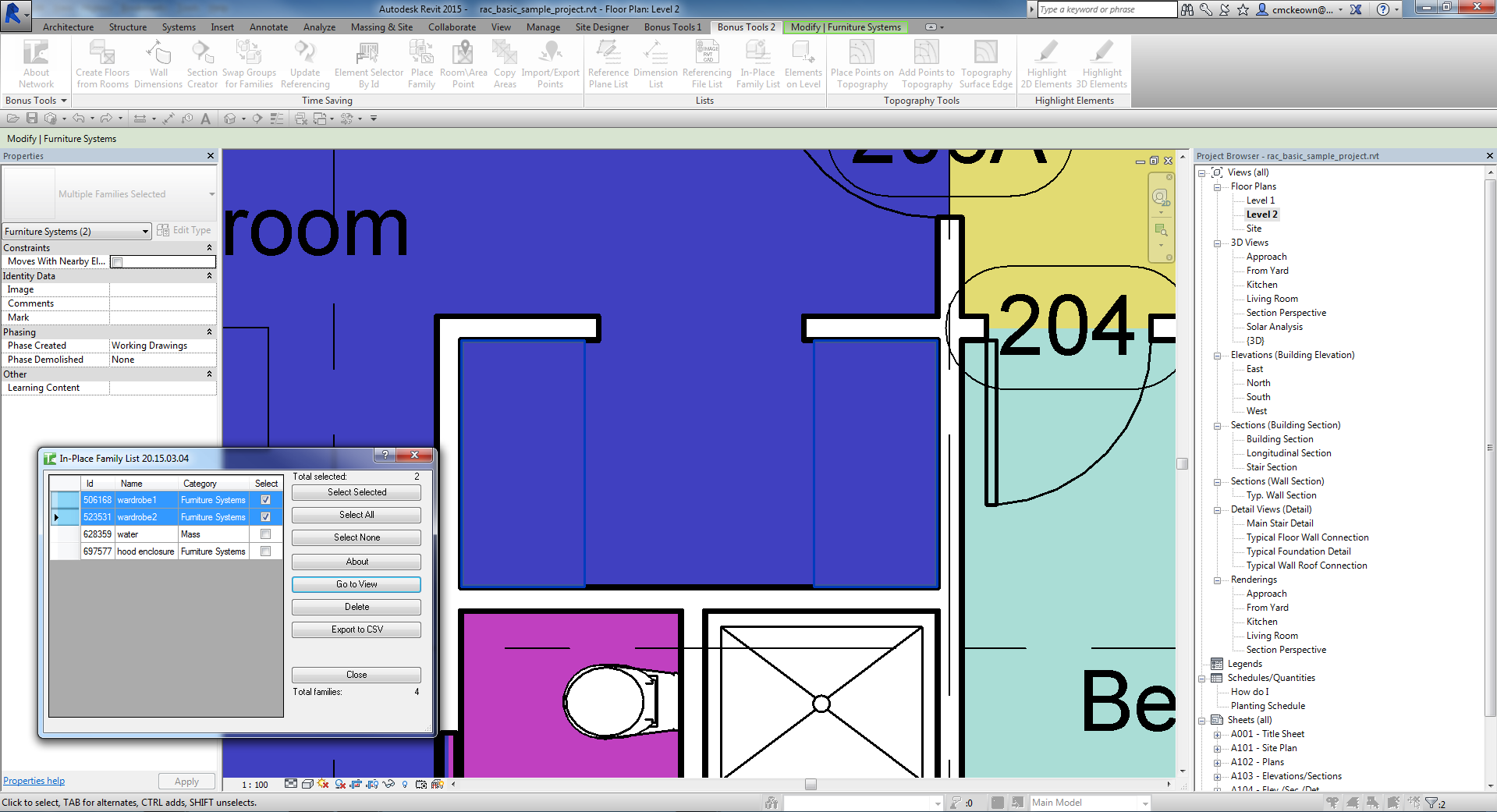
If multiple in-place families are selected across different views, Revit opens the view of the last family in the selection.
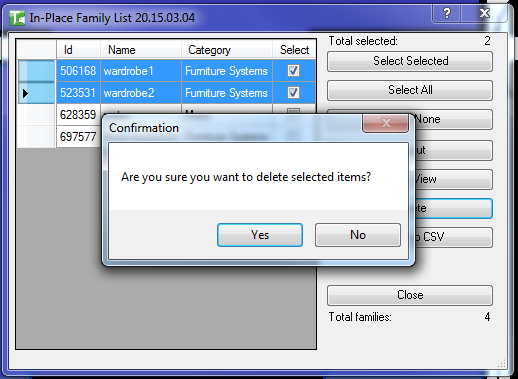
Step 3 — Delete selected families
- Select the in-place families to delete
- Click Delete Selected
- Confirm the deletion prompt
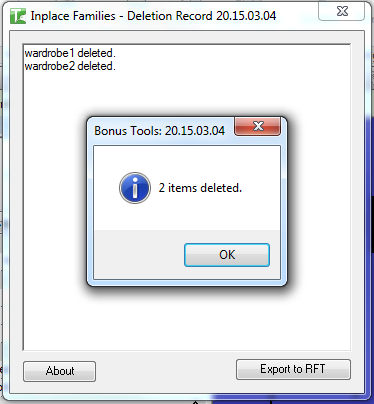
An output dialog confirms which families were deleted:
Isolate and Reset
Click Isolate to isolate selected in-place families in the current view for closer inspection. Click Reset to restore normal view visibility.
Export
Click Export to CSV or Export to Excel to save the current grid. Useful for BIM compliance reporting or handover documentation.
Tips and Best Practices
- Run at project milestones. Check for in-place families at the start, mid-project, and before handover — they can accumulate quickly if team members use them as a workaround for missing content library families.
- Sort by Category to prioritise. In-place families in Structural Framing or MEP categories are often the most problematic for linked model workflows. Sort by Category to find the highest-risk ones first.
- Use Go to View before deleting. Deleting an in-place family cannot be easily undone in a workshared model. Verify the correct family is selected by navigating to it first.
- Replace before deleting. If an in-place family can be replaced with a loaded family type, make the swap before deleting — this preserves geometry intent and avoids gaps in the model.
- Export before bulk deletion. Save the CSV before running Delete Selected so you have a record of what was removed for audit trail purposes.
Common Use Cases
BIM compliance audit — Run In-Place Family List at each project milestone to check the count of in-place families. Export to CSV and track the count over time to enforce BIM standards.
Pre-handover cleanup — Before handing a model to a client or consultant, run the tool, select all in-place families, review by category, and delete any that were created as temporary placeholders.
Finding hidden in-place families — In-place families that are in obscure views or worksets can be nearly impossible to find by browsing. This tool surfaces all of them regardless of visibility.
Discipline-specific review — Sort by Category to review in-place families in a specific discipline's categories (e.g. Mechanical Equipment, Walls) and address them with the responsible team.
Troubleshooting
Grid is empty The project contains no in-place families. This is the desired state — no action needed.
"X passed. Y failed." with failures Some in-place families could not be deleted. In a workshared model, the element may be owned by another user. Borrow or check out the relevant families and retry.
"Inplace Family deletion failed. Gain ownership of elements and try again." The delete transaction failed due to a worksharing conflict. Gain ownership of the affected in-place families and retry.
"Operation Failed." An unexpected error occurred. Check the Revit journal for details.
In-place family appears in grid but cannot be navigated to The family's host view may have been deleted. The element still exists in the project but has no accessible view. Delete the family directly from the grid.